
.gif)


FireBrand™ is Columbia Forest Products’ certified Class A fire-rated veneer core platform for commercial interior wall and ceiling finish applications. It helps architects, contractors, and fabricators meet fire-performance documentation needs while preserving the warmth, workability, and design flexibility of real hardwood plywood.
WHY CHOOSE FIREBRAND?

DOMESTICALLY PRODUCED

CLASS A FIRE RATED CORE

GREAT FOR COMMERCIAL INTERIORS
WHAT IS A CLASS A FIRE-RETARDANT PANEL?
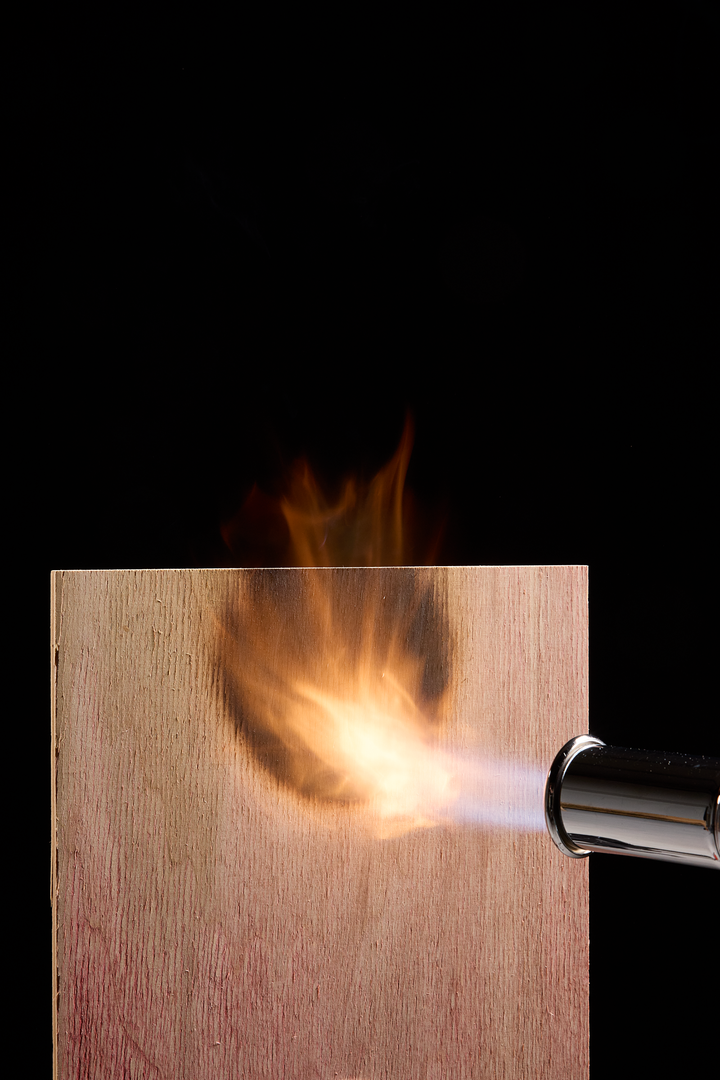
Class A means the material meets the highest standard for fire safety; limiting flame spread and smoke development so the product does not significantly contribute to a fire.
Columbia's FireBrand™ Veneer Core Platforms connect PureBond® formaldehyde‑free assembly with superior fire performance to support safer interiors without sacrificing design or sustainability goals.
Unlike many products that rely solely on developmental testing, FireBrand™ is third-party certified through ICC-ES and meets ASTM E84 Class A requirements for flame spread and smoke development. Available in a range of thicknesses and panel sizes, FireBrand™ allows architects, designers, fabricators, and contractors to confidently specify real wood interiors without compromising project fire-performance objectives.
These cores comply with both the ASTM E-84 Class A requirement for the United States, as well as the S102-18 requirements in Canada.
Columbia offers certified Class A veneer cores in:
-
Thicknesses: 7/16” through 1”
-
Panel sizes: 4x8' and 4x10'
FREQUENTLY ASKED QUESTIONS
-
WHAT DOES "FIRE-RATED" REALLY MEAN?
There are two different Class A requirements for fire-retardant wood products. These standards are often confused but serve very different purposes. In both of these cases, the product must achieve a Flame Spread Index of 25 or less, and a Smoke Development of less than 450, however the length of the test is different depending on the use of the material.
-
Class A for Structural Use
IBC Section 2303.2 covers fire-retardant-treated wood used in structural applications—think roof trusses or framing components. These materials must meet the code’s full definition of Fire-Retardant-Treated Wood and pass an ASTM E2768 tunnel test (30 minutes). This allows for increased structural stability in occupied buildings, which allows occupants longer to exit in case of a fire.
-
Class A for Interior Finishes
This requirement is defined in IBC Section 803 and applies to wall and ceiling finishes. To qualify, a product must pass the ASTM E84 tunnel test (10 minutes). This fire rating is to limit the flame spread and smoke developed inside the rooms allowing occupants more time to exit safely.
Because veneer-cored hardwood plywood is used decoratively, Columbia’s focus is on the interior finish Class A requirement—where beauty and safety must work together.
Not all fire-retardant panels are created - or verified - equally
Many manufacturers choose to get “Developmental Testing” on their products. What this means is that they manufactured the product and had a sample tested. The sample, under those exact manufacturing conditions, passed. In cases where a manufacturer has developmental testing, they can provide those test results to the Authority Having Jurisdiction (AHJ) over the job site, and they can choose whether to accept that product or request the product to be certified.
Specifying a product with Third-Party Certification reduces the guess work for distributors, contractors, and AHJ’s because manufacturers choosing to go this route have taken extra steps to have their process reviewed by a certifying laboratory who audits the process, the quality control methods, and submits to regular unannounced audits of these processes as well as annual re-testing to ensure the product still meets the building code requirements.
Many companies do not understand these nuances and claim to be certified simply because they passed the developmental testing – but it’s important to understand this distinction.
-
IS THE FINISHED PANEL (WITH VENEER) CLASS A?
Much like it works with fire-rated MDF and Particleboard, only the core will be certified as Class A. Once a decorative veneer is applied, the product will once again be Class C.
-
CAN A FABRICATOR LAMINATE TO THIS PANEL?
Any change to the panel beyond cutting/ripping may affect fire performance and should be tested. Adhesives, coatings, and stains need compatibility testing before scaling production.
-
IS IT FSC® CERTIFIED?
Yes — FSC Mix available with upcharge (COC-009098). Please be advised 2026 credits are limited. For FSC orders at volume, please contact us early.
-
IF I WANT TO LAMINATE TO THIS PANEL, WHAT SHOULD I USE?
Fire retardant chemicals may affect the performance of paints, stains, adhesives, and any other surface treatments. Due to the infinite number of available finishes and adhesive products, Columbia Forest Products cannot guarantee the performance of these products in conjunction with the chemistry in the fire-retardant panel. Columbia Forest Products also cannot make recommendations for finishing, adhesives, or any other specific products for use. Further, any changes made to the product may materially change the fire performance, and vice versa, and should therefore be independently tested. Columbia Forest Products accepts no liability with regards to the final use or finishing of its products. It is highly recommended customers perform small-scale testing prior to completing a full production run to ensure compatibility of these products.
-
WHAT ABOUT TSCA/CARB/VOC COMPLIANCE?
PureBond® and FireBrand™ are TSCA Title VI and Carb Phase 2 compliant, and NAF and no VOC.
-
DOES IT WORK IN CANADA?
Yes. FireBrand™ passed CAN/ULC S102.18 and is marketed as an interior finish product.
-
HOW IS FIREBRAND™ DIFFERENT FROM OTHER FIRE RATED PANELS?
Our competitors are primarily offering fire rated panels based on a singular test report and engineering opinion. FireBrand™ is ICC-ES listed — third-party certified with ongoing audits and annual re-testing. An AHJ can look up FireBrand™ directly in the ICC-ES database.
RESOURCES
FireBrand™ Product SheetFireBrand™ Product Sheet FRENCHFireBrand ICC-ES Listing Report ENGLISHFireBrand ICC-ES Listing Report FRENCHFireBrand™ SDS Sheet ENGLISHFireBrand™ SDS Sheet FRENCHFireBrand Finishing, Laminating, & Fire Performance Considerations ENGLISHFireBrand Finishing, Laminating, and Fire Performance Considerations FRENCH
WHERE TO BUY
Whether you're a large contractor or a DIY hobbyist, Columbia Forest Products are conveniently available throughout North America. Find your wholesale distributor or Home Depot store here!